Monday, June 4, 2012

Gleaning Encouragement from Scriptures in Times of Disillusionment


Dear friends,

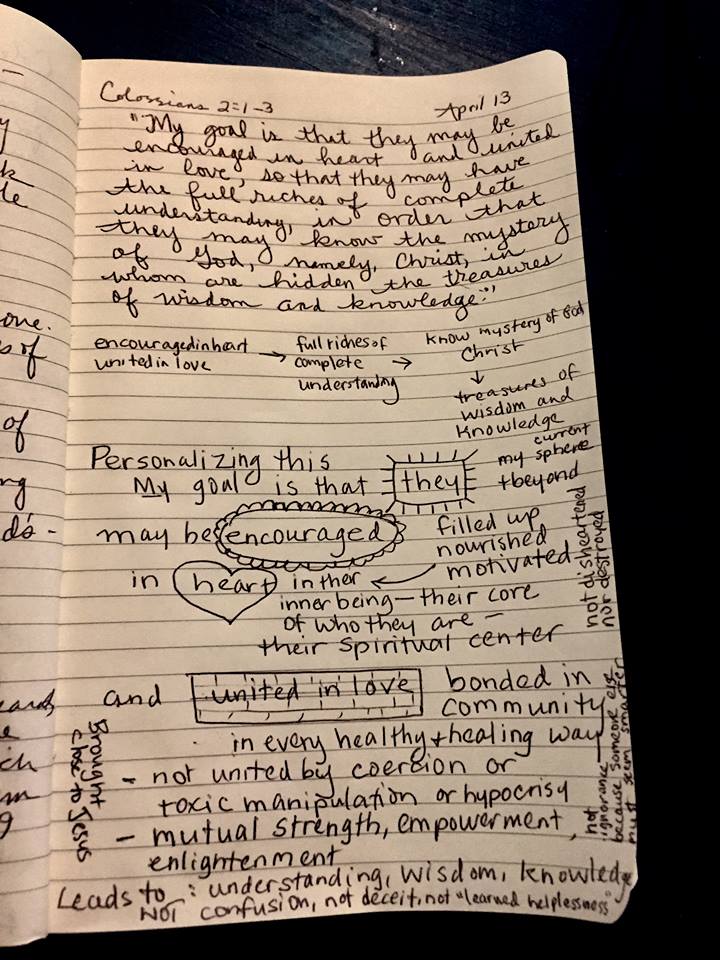
I am trying to dig into the Bible more consistently and more deeply, so I wrote out a little plan of what I would study this week.  It's not because I have to, like I am proving something by checking it off, but because I want to do it and I know it will bring life.   Now that's it's summer, I have a little more time to study, so I am pondering a little from the New Testament, a Psalm, a chapter of Proverbs, and some Old Testament history. Throughout the Scriptures, he meets us where we are.  Here are a few of my thoughts gleaned from this morning's readings, especially for those who may be feeling disillusioned with their spiritual experiences.  

Luke 24:1-8

On the first day of the week, very early in the morning, the women took the spices they had prepared and went to the tomb. They found the stone rolled away from the tomb, but when they entered, they did not find the body of the Lord Jesus. While they were wondering about this, suddenly two men in clothes that gleamed like lightning stood beside them. In their fright the women bowed down with their faces to the ground, but the men said to them, “Why do you look for the living among the dead? He is not here; he has risen! Remember how he told you, while he was still with you in Galilee: ‘The Son of Man must be delivered into the hands of sinful men, be crucified and on the third day be raised again.’ ” Then they remembered his words.

The women had just experienced a huge loss.  Their hopes for the Kingdom of God had been dashed with the death of their messiah Jesus.  And yet they had prepared spices to anoint his dead body.  They were loyal friends to him even in their disappointment, even though he hadn't done what they had come to expect of him.  (I wonder, "What spices can I offer to him out of the ashes of my disillusionment?")  Yet, on stepping out in love in the face of death, they meet LIFE instead!  "He is risen!  Remember what he told you?"  I must remember his words, too, by studying the Scriptures.

Psalm 4

Answer me when I call to you, O my righteous God.
Give me relief from my distress; be merciful to me and hear my prayer.
How long, O men, will you turn my glory into shame?
    How long will you love delusions and seek false gods? 
Selah
Know that the 
Lord has set apart the godly for himself;
    the 
Lord will hear when I call to him.
In your anger do not sin;
    when you are on your beds, search your hearts and be silent. Selah
Offer right sacrifices and trust in the Lord.
Many are asking, “Who can show us any good?”
    Let the light of your face shine upon us, O Lord.
You have filled my heart with greater joy
    than when their grain and new wine abound.
I will lie down and sleep in peace,
    for you alone, O Lord, make me dwell in safety.

When we are disillusioned with other Christians, with delusional concepts that we had believed about God and the church, with false teaching that has brought a sense of shame, it is easy to question, "Who can show us any good?"  Yet we pray, "Let the light of your face shine upon us, O Lord."  What claimed to be light wasn't always light.  We want true light, the light of his face.  We want to live in his joy and peace and glory, not sinning back against those who have hurt us, but trusting him and doing the right thing no matter what someone else is doing.


Proverbs 4 (selected passages)

Get wisdom, get understanding; do not forget my words or swerve from them.
Do not forsake wisdom, and she will protect you; love her, and she will watch over you.
Wisdom is supreme; therefore get wisdom. 
Though it cost all you have, get understanding.
Esteem her, and she will exalt you; embrace her, and she will honor you.
She will set a garland of grace on your head and present you with a crown of splendor. 

Hold on to instruction, do not let it go; guard it well, for it is your life.
Do not set foot on the path of the wicked or walk in the way of evil men.
Avoid it, do not travel on it; turn from it and go on your way.
For they cannot sleep till they do evil; 
they are robbed of slumber till they make someone fall.
They eat the bread of wickedness and drink the wine of violence.
The path of the righteous is like the first gleam of dawn, 
shining ever brighter till the full light of day.
Above all else, guard your heart, for it is the wellspring of life. 
Put away perversity from your mouth; keep corrupt talk far from your lips.
Let your eyes look straight ahead, fix your gaze directly before you.
Make level paths for your feet and take only ways that are firm.
Do not swerve to the right or the left; keep your foot from evil.

Many people who have been burned by churches or Christian organizations are especially vulnerable to "throwing the baby out with the bathwater" and giving up on Biblical truth because it has been so misrepresented.  They either quit trying to figure it out at all, or they turn to other belief systems that prey on their angst with what they have experienced so far in  Christianity. Yet this is the time to be especially discerning, and really turn back to the Scriptures to find the truth.  This is not the time to dabble with unbiblical doctrines or to cut loose with the morals.  This is the time to watch out even more over our beliefs and our practices.  Wisdom is what feeds your heart, and your heart is the wellspring of your life.  Guard them well.

1 Kings 19

This passage is too long to include here, but I encourage you to read it: 1 Kings 19.  Here is a brief summary with a few extra comments...

In the previous chapter, Elijah just won a showdown with the evil king Ahab when God sent the fire down to consume the sacrifice and the altar, showing who was the true God to the followers of Baal.  This is the spiritual mountaintop, a spiritual victory.  Yet now that Queen Jezebel is threatening to kill him, Elijah runs for his life, sits down under a broom tree and prays to die.  Wow! What a crash landing!  Isn't it true that sometimes our deepest depression and despair comes right after we have worn ourselves out with serving God?  Or when we are being challenged even more by our enemies and we forget how God has already shown himself powerful in our defense?  Physical and emotional fatigue and or a big confrontation can really sap us dry.   In his depletion, Elijah slept.  He needed rest. When he woke up, an angel came and brought him food and water, telling him that he needed it for the journey.  No big sermon, just practical help to strengthen him for what was to come, which was a forty day journey to Horeb, the mountain of God.  When Elijah gets there and spends the night in a cave, God asks him what he is doing there.  Elijah replies that he has been zealous, but that he's the only prophet left.  He keenly feels the isolation, and he's throwing a pity party for "me, myself and I" since no one else was there. The Lord said, "Go out and stand on the mountain in the presence of God, for the LORD is about to pass by."  A powerful wind and earthquake and fire all came, but God wasn't in those.  Instead, he came in the the gentle whisper. Isn't that true?  Sometimes we are looking to the spectacular for the presence of God.  We run after the miracles, after the celebrity preachers and the big conferences, after the dramatic experiences.  Yet sometimes he comes to us in a quiet word when we are all alone.  That's when he lets us know that we really aren't alone, that God is there, and that there are other authentic believers to partner with us withi fellowship and ministry.  God told Elijah that he had reserved 7,000 faithful prophets.  He also commissioned Elijah to anoint two kings and a prophet to succeed him.  He still had work to do!  And now he was going to get a much needed helper, Elisha!  Be still and know that he is God.  Listen to his quiet voice.  I think there is much to learn from this passage to help us keep going when we are worn out and facing opposition.

I hope these thoughts have been encouraging to you.

What is God teaching you from the Bible?

Blessings,

Virginia Knowles

Tuesday, May 15, 2012

Recovering, Still...

Dear friends,


Spiritual abuse is in the headlines again with ABC News covering a case in Oregon where a blogger, her family, and a few friends are being sued for half a million dollars by their former pastor.  I can certainly relate to Julie Anne, who had already contacted me a while back to ask if she could link to this blog after finding it via Wartburg Watch.  My question now: "Just when will abusive pastors finally learn that they cannot bully members into silence over legitimate concerns?"  Blech.


Anyway, I was thinking this morning about all I have read and experienced about recovering from a negative religious experience such as authoritarian abuse with a church or other Christian organization/movement.  I'm including a bunch of links below about what other people have observed, but first a few things that helped me transition out of a less-than-ideal-for-me church situation.


First, I took the time (actually a few years) to think through what was really bothering me, to try to evaluate it according to what I knew from more than 30 years of studying the Bible, to read as much as I could from a wide variety of trusted sources to confirm what I was thinking, and to get advice from wise friends and counselors.  A professional Christian counselor, Roger Shepherd of Florida Counseling Foundation, has been extremely helpful even since before we left our last church.  He has had personal experience with abusive Christian organizations and has counseled other people in my kind of situation.  (One of the key things he told me is that forgiving someone does not mean that you need to ever trust them again.  Trust is earned back over time or maybe even not at all.  It should not be granted automatically.) Since that time, I have continued to research about spiritual abuse and recovery, as well as explore what it is that I really believe about grace, the nature of the Christian life, authority, family dynamics, social issues, and more.  I still talk to supportive friends, many of whom have been in my shoes in some way. 


Next, since I highly value being in a church setting and didn't want to throw the baby out with the bathwater by rejecting "organized religion", I spent the time to research what I wanted in a new church.   (I was the one in my family to do this, since I was the most motivated and the most computer savvy, but I communicated regularly with my husband about what I was finding.) Over a period of months before we moved on, I asked around, surfed the web, and listened to sermons on-line. I made a short list of churches that our family might consider and talked to my husband and children about the options.  We had to think about priorities.  For example, mode of baptism was not as important as the polity (church government) and the leadership atmosphere.  A smaller size was more important to one of my teens than a super fancy youth ministry.  A genuine warm welcome (not "love bombing") was more important to me than whether the church owned its own building.  When I found a potential church that looked especially good, I called a friend who had attended there for a few years and grilled her for about an hour. :-)  It took us a few more months after that to visit our mellow little PCA church the first time, but we've been there for a year and a half.   The pastors, elders and other members have been extremely supportive in light of our prior church experience. It has been a safe place where I can breathe and recover.


I have attempted to stay on good terms with our friends and pastors from our former church.  Yes, this has been a little bit of a challenge because of what I have written on this blog and my main blog, but I am pleased to say that only a few people told me to bug off, and those who were truly my friends are still my friends.  I know some folks have been shunned by members of their former churches, but that really hasn't been an issue for us.  (Maybe because so many people left at the same time, it was harder to write all of us off at once, especially since many who left had been there over 20 years and were "pillars of the church.")  I also stopped to think (and write about) what I appreciated about our former church, and to be thankful for the good things I learned and experienced there for eight years. 


Another key thing has been giving myself permission to handle this transition at my own pace without expecting too much.  It certainly wasn't over the minute we stepped into our new church, and frankly, not all of my issues were even caused by our old church in the first place.  From what I've read on web sites about spiritual abuse, these kinds of situations can trigger PTSD (post traumatic stress disorder), with the associated depression, anxiety, anger, apathy, disillusionment, distrust, relational conflict, and spiritual doubt.  I have experienced all of these, every single one of them.  It can be a complicated tangle that takes time to sort out.  Some people never want to set foot in church again.  Some leave the faith entirely.  That is not my case, but there are some phrases, songs, subconscious impressions, and even Bible passages that give me a spiritually allergic sensation and make me recoil.  I ask myself, "Why am I reacting like this?" and try not to let negative associations ruin otherwise good things.  It is especially comforting to know that God is big enough and loving enough to handle my angst.  (I certainly relate to David's angsty laments in the Psalms!)  I find that I am much less "put together" than I thought I was before, but I've also learned to be OK with that. I have the freedom to live outside the box of other people's expectations of what it looks like to be godly, like home schooling every single one of my kids.  I give myself credit that I haven't bolted from the Christian faith, and even if I don't always know which end is which or what I want to be when I grow up, at least I'm still here!


Journaling is also important to me.  Writing it out clarifies some of the issues, and helps me to go back later and reconsider what I had been thinking before.  Sometimes I see a little bit of progress from then until now, and other times I have to go back and reclaim some of that progress that seems to have slipped.  For me, journaling is a private matter.  No one has permission to read them.  It has to be a safe place to let it all out without the fear of having to explain it to someone who might misinterpret what I'm saying.  I also journal as I read the Bible, summarizing what I read and how it applies to me at the moment, right where I am.  Psalms, the Gospels and other narratives, and the book of Ephesians have all been very refreshing to my soul.  Journaling is also a form of prayer for now.  Extended prayer during my "quiet time" is still a hard thing for me.  Other than writing, it is more stream of consciousness prayer for now, thinking Godward as I go through the day.  Often it is just "Lord, have mercy" or "Sweet Jesus, help me."  Blogging is obviously more public than my journaling, but it is a huge help, too.  I have always said, "I write to stay sane" and that is more true than ever. :-)  Most of my blogging is not about spiritual abuse but observations about daily life.  Take a peek at www.VirginiaKnowles.blogspot.com and www.ComeWearyMoms.blogspot.com.  You might especially like to read Knowing She Hath Wings.


One more restorative gift is appreciating the beauty of nature that reminds me that God is a Magnificent Creator.  Clouds, flowers, tree trunks, sunrises -- all powerful for building trust in the goodness and power of God!


What about you?  What has helped you recover?  What didn't?


This list of links can also be found on my Links page, along with a bunch of others on specific organizations, family abuse, patriarchy, and home schooling. Please note that I do not endorse everything you will find at these sites.  I trust you will use your own God-given discernment.


Recognizing and Recovering from Abuse or Legalism

Spiritual Abuse Recovery Resources http://www.spiritualabuse.com/  This site by Jeff VanVonderen (author of The Subtle Power of Spiritual Abuse and Soul Repair) is full of articles and links to other sites.


What is Spiritual Abuse? http://www.spiritualabuse.org/introduction.html (site is mainly addresses United Pentecostal Church abuses, but this page is good general info and includes a video interview with Stephen Arterburn about Toxic Faith: Surviving Spiritual Abuse)

Church Abuse http://www.churchabuse.com/ -- another good general site with plenty of links and articles

Spiritual Issues in Recovery 
http://www.geftakysassembly.com/Reflections/Recovery.htm (this site addresses the implosion of the Geftaky Assemblies, but has a lot of valuable information for spiritual abuse recognition and recovery)

Emerging from Broken: http://emergingfrombroken.com/

Ill-Legalism: http://ill-legalism.com/

Beauty n Mess: http://beautynmess.blogspot.com/ (by a former SGM member)


Tuesday, March 20, 2012

Why I'm NOT a Fan of Mark Driscoll, Real Marriage, Mars Hill, Acts 29

Note: I think I hit a nerve with this one, with several hundred page visits since I wrote it a few days ago.  It seems to be a hot topic on Google searches!


Dear friends,


If you have read much of this site, you know I have had some experience with what I would consider to be an unhealthy church organization.  Unfortunately, that organization is not alone in its troubles.   Mark Driscoll is lead pastor of Mars Hill Church and president of the Acts 29 church planting network.  [Update: Since I first posted this 10 days ago, he stepped down from leading Acts 29 and is handing over the reins to Matt Chandler.  See  A Note on Some Transitions. He is also resigning from leadership in The Gospel Coalition. See Driscoll Steps Down from TGC Council.] Driscoll has been in the news (including major secular media outlets) with the recent release of Real Marriage, the book he wrote with this wife Grace, which I do not intend to read.  Unforunately, he has also been facing serious allegations of spiritual abuse for many years.


I first heard of Mark Driscoll either because I saw his books in our former church's bookstore, or because a friend who knew I was researching problems in the Emerging Church movement, sent me a link to an insightful audio that Mr. Driscoll had produced on that subject.  My first impressions of Driscoll were favorable, based on that limited exposure.  Because of this, when I heard that he had released a free e-book for dads, I downloaded it to pass along to my husband.  Browsing through it, I was extremely disheartened (actually rather disgusted) by his attitude toward women.   Here is one of the offensive excerpts from Driscoll:
"Proverbs 19:13 further stresses the correlation between the type of mother you choose for your children and the kind of children you will have, saying, “A foolish son is ruin to his father, and a wife’s quarreling is a continual dripping of rain.” These two miseries simply go together. If a wife is a nag who disrespects her husband by chirping at him all the time, then the children in that home will follow her example and become fools who ruin their lives by similarly disobeying and dishonoring their dad. Wicked women not only fail to restrain their tongues in front of their children, but often intentionally attack their husbands in an effort to get their children’s allegiance, undermine the authority of their father, and bring anarchy to the home. Proverbs rightly calls this rottenness in the bones.... Whose responsibility is it? Ultimately, it is men who are responsible because they chose their wives, they let them continue in sin, and they let them destroy their children."
Dude!  So let me get this straight... If a wife is expressing her discontent to her husband in ways that are unpleasant to him, then the real problem is that she is a wicked woman and he has not corrected her firmly enough?  Excuse me? Try again?  How about this: if the wife is upset with her husband, he might have a really good reason to ask her what he has done wrong?  Maybe he has been crass, demanding, unreasonable, obnoxious, and/or verbally & physically abusive?  Or maybe there has been some sort of misunderstanding?  Or maybe she has been cooped up with a bunch of noisy, messy kids all day, and she's losing her cool?  (And then maybe he came home, took one look around, and asked what she had been doing all day?)  But oh no!  She's a wicked fool and needs her Knight in Shining Armor (whom she obviously does not deserve) to set her straight.  I guess hubby better get some tips from Driscoll on taming his shrew.  Oy.  Unfortunately this is not just an isolated sound bit pulled out of context.  It gets worse, much worse, the more I read on-line about other things he has said.


Not surprisingly, my new impressions of Driscoll's ministry were quickly confirmed as I started to see a plethora of commentary about this very thing on-line, along with the accusations of spiritual abuse at Mars Hill.  Much of it echoes the very same things that have happened in our former church organization, including dysfunctional church polity (government), authoritarian leadership, lack of accountability for top leadership, church discipline gone amuck, an overly intense focus on sin, misogynistic views of women, and much more.  Oh, and the way Driscoll entirely dismisses preachers in Great Britain with: "Let’s just say this . . . right now, name for me the one young, good Bible teacher that's known across Great Britain. You don’t have one – that is a problem. There's a bunch of cowards who aren’t telling the truth.  You don't have one.  You don't have one young guy who can preach the Bible that anybody's listening to on the whole earth."  


Then, too, with the release of his new book, there is a renewed concern about his graphic teachings on sex, and on his rough language in the pulpit. 


Needless to say, when it came time to look for a new church two years ago, I made a point to stay away from the Acts 29 churches in our area. I am seriously not amused.


Rather than me laying it all out from my limited perspective or even hunting up all of the Mark Driscoll quotes that make me shudder, I thought I would provide you with about two dozen web links that I have discovered in the past few years.  I hope that this will be helpful to you, even if you don't read his books or participate in his ministry.  It is a cautionary tale for Christendom.  It's not just SGM or the IFB or Mars Hill, folks.  Watch where you go and whom you allow to influence you!


Please note that I am giving you these links to use with your own God-given discretion. 
I do not agree with everything you will find at these sites.


Mark Driscoll and Mars Hill
Real Marriage Reviews and Media Appearances 
(Some favorable, some not, some mixed...)


  • Mark Driscoll’s Sex Manual ‘Real Marriage’ Scandalizes Evangelicals
  • Q & A: Mark and Grace Driscoll on Sex for the 21st-Century Christian at Christianity Today
  • Mark Driscoll on Piers Morgan – Interview Transcript
  • Review at Parchment and Pen (Credo House) mixed reaction
  • Review by Andy and Wendy Alsup at Practical Theology for Women  This review has positive and negative things to say about the book, and contains a lot of background info on the Mars Hill situation, as well as a call for Driscoll to repent.  One quote: "In Real Marriage, Mark acknowledges a past problem with pride, but he remains blind to his self-centered view of the church, the extent of his disqualifying anger problem, the true root causes of both in his life, and the long term effects that both have on those around him. When you can flippantly write off 1000 members in your church, including elders, deacons, and community group leaders, because (as he explains it) you're burnt out based on long standing bitterness and sexual frustration with your wife stemming from a sexual encounter when she was a teenager 19 years before—well, wow, I'm at a loss for exactly how to address that."
  • Review by Tim Challies  Excerpt: "Noticeably absent in this section is a firm and robust gospel grounding for marriage. Ephesians 5 is referenced only in passing; the marriage relationship as a mystery, a picture of Christ’s relationship to the church, is never clearly offered as the big picture or ultimate purpose of marriage. That gospel foundation is utterly, absolutely critical to an understanding of marriage and it is missing from Real Marriage. This is a tragic oversight. And I say “tragic” because the biblical understanding of marriage influences everything else—everything they discuss from chapter one to chapter eleven..... Mark’s abuse of The Song of Solomon has been widely noted and discussed, but he continues to treat it as a graphic sex manual. To treat it this way is to utterly miss the point."
  • Purity balls, Christian princess syndrome, and “mom” haircuts: evangelicalism’s mixed messages for women by Karen Campbell at www.thatmom.com.  An excerpt: "Recently reading excerpts from Mark Driscoll’s latest book along with seeing some of his teaching videos has left me feeling the need to retreat into a safe place and take a bubble bath for my very soul."
  • Mark Driscoll's 'Real Marriage' Draws Controversy for 'Invasive' Sex Talk  Excerpt of review: "This chapter has the potential to wreak havoc in such marriages where one spouse will feel a whole range of taboos to be 'permissible' if he can convince his spouse to participate," said Burk. "This to me seems like a recipe for marital disaster, and I do not think the Driscolls' requirement of 'helpfulness' mitigates the difficulty."

Thursday, January 12, 2012

Why the Church?


Dear friends,

I know I've posted a lot this year on what can go wrong in churches.  I know that sometimes it's tempting to get down on churches if you've been hurt before, but there is a good reason for them!  Actually, several!  Here goes!  (Note: I originally wrote this article many years ago in the context of the home schooling movement.  If you aren't teaching your kids at home, just ignore those references!)

Why the Church?
           
            I’ve noticed a lot of discussion (and debate) in home schooling circles about “the church” -- what it is and what it should be like. I know there are many home school families who are as cynical toward the organized church as they are to the public school system. In the past 30 years, due to family moves and other providential circumstances, I’ve had the privilege of membership in over a dozen congregations with slight to moderate variations from one another.  Each one was manna to my soul in some way or another! As an avid student of theology, I care deeply about sound doctrine, but I’d rather be in an imperfect church than none at all.  If I ever find the perfect church, I won’t attend it, because I wouldn’t want to ruin it!  Yet we have also left churches because the problems were serious enough that we needed to find a healthier place to worship and grow together.  I see this as a matter for serious prayer and contemplation.

            I think home school families face some unique challenges with the churches they attend.  On one end of the spectrum, some churches seem apathetic or even antagonistic to the home schooling lifestyle, making you feel "weird" and old-fashioned. Or you might worry about worldliness of other kids or the wishy-washy doctrinal teaching within the youth program. This can certainly be a concern, because you have little control over what resources they choose to use, and the Emerging/Emergent church movement (which is quite often heretical) is making deep inroads in youth ministry programs within evangelical churches.  I really appreciated one of our former churches, which highly encouraged and even expected parental participation in all youth meetings. We knew what our kids were learning and had the chance to follow up with them about it later. It also gave us the valuable opportunity to get to know and observe their friends, which was quite important to me.  

            On the other hand, you might encounter a church where the home schooling lifestyle is firmly entrenched or even mandatory for those who are core members or leaders.  Here the challenge is more of conformity and control.  This sometimes escalates into the abuse of spiritual authority, especially in churches with roots in the shepherding movement of the 1970's.  In a legalistic church, if your family doesn't fit in with what is expected, you may find yourself on the outer fringe, deemed second class citizens. Or, if you do fit in, you might be tempted toward elitist self-righteousness and make other people feel unwelcome.  In some ultra conservative home schooling churches, there are rigid man-made standards for dress, worship style, entertainment, etc.  Are people treated as pariahs if they don't toe the line?  Will they be kicked out of the proverbial holy huddle? How will this rejection affect the children, especially the teens? Will this pull them toward outward conformity (accompanied by depression or anxiety when they can't measure up) or push them into  overt resistance (often labeled rebellion by the overzealous) because they rightly discern that the standards are ridiculous?  Either way, it is not likely to nurture them into a full and vibrant faith.  They will see the lack of warmth and joy and be repelled.  Can we then blame them for latching on to wild and crazy friends who at least accept them for who they are and know how to show them a fun time?  Yes, churches need to have reasonable Biblical standards for behavior, but there also needs to be a whole lot of grace and exuberance for life that makes it all possible and worthwhile.   Ask yourself, "How is my church affecting my level of joy, peace, and compassion?  Am I drawn to worship God from the heart?"


"The Lord says: “These people come near to me with their mouth and honor me with their lips, but their hearts are far from me. Their worship of me is based on merely human rules they have been taught." Isaiah 29:13

            Fortunately, church does not have to be an ordeal.  There are plenty of normal, grace-filled, life-affirming churches to choose from.  Don't give up your search!

            The most important reason for the church is that Christ himself established it. Yes, we automatically become part of the universal Church when we become part of Christ, since the Church is his Body. But there is also a need for faithful fellowship with other believers in your geographical area. Web boards, e-mail lists, and TV broadcasts may enhance our Christian growth, but they are no substitute for the living, breathing local church.   A local church offers a diverse mix of backgrounds to broaden and deepen our spiritual lives. What a joy it is to walk into the auditorium each week and see people so different from me! “Every color, dark or light, they are precious in his sight!” Jesus is Lord, not just of white middle class Americans, but over every nation, every skin tone, every socio-economic status and educational level. This kind of healthy diversity builds respect for others into the lives of our children. There is no sense of us versus them but of being dear brothers and sisters in the Lord. I can learn from those who are further along in the Christian journey, while at the same time helping others along the path.
           
            A local church offers flesh-and-blood accountability. I know how easy it is to drift in the Christian life, even after decades in the faith. Having people personally looking out for my spiritual life is a vital safeguard for my faith. I’m not talking about an invasion of privacy here, just a valid concern that allows certain people to ask, “What is the Lord teaching you right now? Is there any way I can help you through your struggles?” If there is a disagreement, this is a valuable opportunity to be like iron that sharpens iron to one another. If I get off balance, my brothers and sisters can bring me back to reality again. Most likely, I’ll even be prevented from getting to that place because I am hearing the whole counsel of Scripture wherever I turn in the church!

            A local church offers in-depth teaching and corporate worship. The good pastor invests hours of his time to prepare his message each week.  He wants build his flock through the public preaching of Scripture rather than amuse them and make a name for himself. Likewise, the musicians work hard so we can lift our own hearts in praise to God. Rather than find all the reasons why we didn’t like the sermon or the music, do we take the time to express our sincere appreciation to those who so faithfully serve us? What a responsibility!

            A local church offers a place for adults and children to develop and exercise spiritual gifts and works of service. The preacher can’t do everything by himself!  Each member must do his or her own part, though mommies with little children must certainly be careful not to overdo. It is especially encouraging to see young people being mentored into church life by serving on the worship team, reading the passage at a Bible study, scrubbing floors, collecting the offering, tutoring students, serving meals, or watching out for the wee ones at a church function. This is such a practical part of their training into maturity.

            A local church can choose to offer educational opportunities to round out what we are trying to do at home.  Our former church offers a lot of support for home schooling, through tutoring classes in high school math and science, free enrichment classes for all ages, support meetings and workshops for dads and moms, and used curriculum sales.

            A local church supports missionaries in other lands. Part of a church’s budget is usually set aside to extend the gospel around the world through financially sponsoring missionaries. Many churches send members on short term overseas outreach trips, including whole teams of teens and young adults.

            Yes, your local church can be one of  your most important support networks in home schooling!  What can you do to serve and grow?

~ * ~
             
            As a part of the body of Christ, you are connected with your Christian sisters and brothers.  As a home school mom, you are connected with others who are investing in their children's education.   We all need a strong network of give-and-take relationships, so take the effort to invest your life in others beyond your home.  Get involved in a local church and a home school support group.  Find a mentor.  Be a mentor!   We all need somebody to lean on!

Monday, October 3, 2011

Why Am I Still Writing About Abuse?


Why Am I Still Writing About Abuse?


“I know that charity covereth a multitude of sins; but it does not call evil good, because a good man has done it; it does not excuse inconsistencies, because the inconsistent brother has a high name and a fervent spirit; crookedness and worldliness are still crookedness and worldliness, though exhibited in one who seems to have reached no common height of attainment. ~ C.H. Spurgeon


Today’s post is very brief, just a little on why I am still writing about abuse in churches, Christian organizations and families. 

A friend asked recently why I read and write so much about various kinds of abuse in churches, Christian organizations and families.  This has been one of my major interests in the past few years, and I’ve been much more vocal in the past year.

My reasons? 
  • Because it still happens
  • Because it is serious
  • Because it affects people I care about
  • Because not enough people are aware of it
  • Because something can be done if people are willing to speak up and speak out
Do I write out of fear?  No, I write because I have lost my fear.  I am gaining new God-given confidence every day.  Do I write out of bitterness?  No, I write out of compassion, because I can’t stand to watch people I love or even people I have never met get hurt.   I want others to experience the mercy and grace I have found.

I wish I could share with you some of the letters that arrive in my inbox each day as a response to what I’ve written so far, but for discretion’s sake I won’t.  I will tell you that they are heartbreaking.  Families are hurting.  Badly.  Multiply that by the stories I read on blogs, especially by those who have been wounded by the patriarchal edge of the home schooling movement.  Ouch.  Oh, and the news stories.  Sweet heavens, when will it end?

I’ll just leave you with several recent links for more reading.  There are so many more I have read recently, so this is just a very small sampling.

Another death in a home school family following Pearl discipline: Seattle Times article “Murder Charges for Parents Who Left Girl Outside”

Recovering Grace is especially for those raised in Bill Gothard’s ATI/IBLP programs, but really helpful for anyone who has been harmed by legalism

Spiritual Abuse by Tim Challies and Bob Kelleman at http://www.challies.com/


What is Abuse? By Hilary McFarland of Quivering Daughters (abuse in some large home schooling families)

Friday, September 9, 2011

Wisdom from Letters of Direction by Abbé de Tourville

Dear friends,

Yesterday I stopped by my favorite used bookstore, Brightlight, to check on some books I had brought in to sell to them.  I took a brief browse in the vast theology department and picked up a small vintage volume, Letters of Direction by Abbé de Tourville, who lived from 1842 to 1903.  Henri de Tourville was a French priest (Abbé) whose health broke from intense parish ministry, so he retired to the countryside and continued to write and minister in his own way.

I love old books, especially those of a contemplative Christian nature.  As an evangelical Presbyterian, I wouldn’t pretend to agree with the doctrines of Henri de Tourville’s Catholicism.  (Nor do I agree with every doctrine in the PCA, such as infant baptism.)  But I also realize that we all have much to learn from one another, and I certainly have found wise, refreshing, and liberating words on the yellowed pages of his little book.  I am thankful that Miss Lucy Menzies, a Scottish scholar with Presbyterian roots and later membership in the Church of England, invested the time to translate it with such clarity for English readers in 1939.  Her colleague Evelyn Underhill (already a familiar name to me) wrote the forward to this edition.

I read 9 of the 20 chapters of the book last night and this morning. I planned to type in several favorite passages to include here,  Fortunately, a quick web search yielded blogs such as My Soul Thirsts for God which had already done so, though I did add some of my own, most notably the paragraphs at the end from his chapter on education, as noted. I think I will still scan in as many pages as I can so I can print them out and make notes on them.  I would hate to deface such an old book beyond the small marginal marks already made by a previous reader.

What I most appreciated about this book is the concept of us being unique individuals before God.  Though we are connected in the Christian community, we are each responsible for our own spiritual growth.  We each grow in our own ways.  We are not cookie cutter Christians.  This is such a freeing idea for those who have been members of high control religious organizations where groupthink is the modus operandi. 

Abbé de Tourville also affirms the love of God for each of his children, and encourages a relationship of childlike simplicity and trust in his goodness.  He cautions against too much introspection and dissatisfaction with our own souls, pointing us instead to the grace and mercy of God, who understands our human weaknesses.

Another thing I appreciate is that he was so forward looking, and though a contemplative, so eager to urge his readers to action in fulfilling the purposes for which God had specially created each of them in making the world – the here and now – and better place to live for everyone. 

Please note the quotes here are not necessarily in a continuous stream.  They are from throughout the book.

You can find the book used all over the Internet.  Here is a direct link for Amazon:


I encourage you to read the quotes slowly and carefully, reflecting on what they mean and how you can absorb them into your own life.

Without further adieu, I give you excerpts from…

Letters of Direction by Abbé de Tourville

Life is a glorious road which leads to incomparable splendour, to the very life of God, to the goal of all things, to the full fruition of all that our hearts hold within them -- as if in a broken but carefully riveted vessel of which the pieces, though broken, yet hold firmly together.

Let us be able to depend quietly on ourselves. Let us judge for ourselves which things most help, guide, and teach us, by observing the degree in which they fit our own particular temperament; learning by experience those things which help us and which we most need.

Live according to your own nature; inwardly without restriction; outwardly in so far as external conditions permit.

One of the hardest things is to follow our own particular line of development, side by side with souls who have quite a different one; often one opposed to our own. It is natural for youth to hesitate between an attitude which it fears may be presumptuous and a candid admission of inferiority to everything around it. But this hesitation must cease or we will never grow up.

Still less must we look for approval and appreciation as a sign that we are on the right path.

We must therefore free ourselves absolutely of this anxious desire to be at one with other souls, however virtuous or wise they may be; just as we must never expect them to see things through our eyes. We must follow our own light as though we were alone in the world, save as regards to charity to others.
  In purely private matters, we must never be deflected from our own path.’

Therefore leave your soul to pray as suits it best, in its own way, without strain. Allow it most of the time to remain quiet, still. In a word, follow your bent.

For nothing is more individual to each soul than the form of its intimacy with our Lord. His earthly life revealed also that no two were intimate with Him in the same sort of way.

Observe the path you take instinctively at those times when you are most keenly aware of the real and intimate presence of our Lord. Realize that there lies your own particular grace.

We must follow our own path and not worry about the puddles into which we fall. The journey itself repairs the accidents into which it has led us. Tidy and timid travellers are never good travellers.

Between the extremes of foolhardiness and timidity, boldness is true wisdom.

A perfect childlike simplicity puts us at once into intimate relationship with God, without any hindrance. Let us try more and more to maintain in the depths of our souls the childlike simplicity and artlessness which our Lord asks and commands.

From every point of view we gain infinitely more by looking at our Lord, than by looking at ourselves. We shake off our faults more quickly and effectively when we adore our Lord than when we examine and criticize ourselves.

The soul gains very little from looking at itself. Such an occupation gives rise only to discouragement, preoccupation, distress, uncertainty, and illusion.

God asks only one thing—that you should be on close and friendly terms with Him, without fear; without ceremony.

Our Lord is our true and chief Director, who, without our knowledge, has arranged matters in such a way that our lives turn out quite differently from what we should have expected; infinitely better for our salvation and glory than we should ever have dared to hope.

Be bold enough always to believe that God is on your side and wholly yours, whatever you may think of yourself.

Think of this and say to yourself ‘I am loved by God more than I can either conceive or understand.’

Rejoice that you are what you are; for our Lord loves you very dearly. He loves the whole of you, just as you are.

Remember that it is our souls which are God’s joy; not on account of what they do for Him, but on account of what He does for them. All that He asks of them is to gladly accept his kindness, his generosity, his tolerance, his fatherly love.

Do not worry any more about what you are or are not. You are the object of His mercy. Be satisfied with that and think only of that.

The Mystery of grace which works in us is in a sense a copy of the Mystery of the Incarnation. By grace Jesus takes possession of our personality and fills it with His Divinity. He desires to make use of us by grace as he made use of His own nature in the Incarnation.

The intimacy of the soul with our Lord provides our true nourishment, our true home, however much circumstances change.

The root of many of our troubles is the desire to have only good inclinations. That is neither necessary nor possible. In countless ways we shall always feel ourselves to be wicked, unstable and unreasonable. We must realize that this is our nature and not our real personality; not our true, deliberate and voluntary desire; not the goal of our efforts. [Rom 7]

Far from your defects being charged against your soul and conscience, they are, before God, your defense, your justification and your glory.

What you need to realize is that a good state of soul can, in this world, go hand in hand with a feeling of deep inward disharmony, of confusion and cloudiness.

Do not fear things too much, for we often suffer more from the things we fear than from those which really come to pass. And what good does it do, seeing that when evils come, they bring with them strength to enable us to accept them; a strength which we do not have in advance.

It is not right to groan over the state of the world as if it were lost.  What is actually happening is a clash between the old spirit and the new, a clash which is specially noticeable because the old spirit is realizing how old it is and how nothing is looked at any longer from its point of view. It is a great struggle of which the issue is never in doubt, a struggle in which that which is coming triumphs over that which has been.

Most people are like sheep and follow, without much satisfaction to themselves, the lines of the past tradition.  A very small minority emerges, with great hesitation and amidst endless discussion to be faced by troublesome and pressing contradictions.  It is however of that minority that you must be, when God has put you there by interior vocation and natural aptitude.

We live in a time of transition in which many things separate the present and above all the future, from the past. Such times are always difficult, but we rejoice when we see the light dawning beyond the clouds, clouds which have been piled up by ways of speaking, ways of judging, ways of acting, which are no longer those which the need of souls imperiously demands.

If shadows cross your mind on matters of faith, it is because all this has been so little taught in relation to our actual needs that we cannot always see our way.  In this century everything has to be remade, even that which does not change in itself.  Take nature, for instance.  Has it changed?  And yet you see in your chemistry and physics how the manner of knowing it has changed.  Methods have improved and the same things are seen more clearly.  That is precisely what is needed in matters of faith.

The absorbing interest of the present day is that the world is growing itself a new skin.  We realize that the heavy mantle of the past, of all those things which no longer have any meaning for our minds, is slipping irrevocably away and leaving our souls free.  The horizon broadens and lights up instead of closing down upon itself and becoming more and more obscure. I want this to be your attitude.  I find that it brings peace and serenity to all those whom I am able to persuade of its truth.  The horizon broadens and lights up instead of closing down upon itself and becoming more and more obscure.

How beautiful is the ordering of the social world and how valuable its knowledge - as infinite as the stellar universe, as ordinary as the lighting of a fire.

Come!  Come! We must wake up and try to be that which we are reasonably meant to be and not that which other people have been.  One does not become holy by copying others but by making good use of what is truly part of oneself. In a word, follow your bent, your need of quiet or of doing nothing according to what seems most natural to you at the time.

[I am typing the following passages from the chapter “Our Relationships with Others: Education” and taking them to heart as both a veteran home school mom and a classroom teacher.  They are really good for all of us who desire to help others spiritually in any kind of ministry.  We are not here to control others or make them conform to our own agenda, but to help prepare them for the future.]

Set aside everything which might make you at all touchy or timid and let all your qualities of goodwill, frankness and simplicity shine forth in your dealings with every one you meet.  Never mind how different their characters and way of life may be, for our Lord desires us to behave thus even to the unrighteous which would otherwise be difficult.

Encourage with discretion all that is good in your pupils; let them feel your support without being embarrassed or hampered by it.  Education, as the very word shows, means helping someone to develop himself, to draw out all that is good in him.  It is the greatest of all benefits.  That too is the meaning of the expression to direct¸ direction.  Unless interpreted in this sense, I like the word formation less; it seems to me to carry the suggestion of a preconceived form into which one is to force people whether they like it or not.  But people do not lend themselves to this kind of treatment and so the form remains empty.

We must not bury ourselves in the gloomy thought that everything is going wrong; nor let it be a matter of indifference to observe which way God appears to be moving in order that we too may move in the same direction.  This is especially important for those who are responsible for education; for the formation of those who will see the future and who will more or less make it.

In what direction is history moving at the present time?  That is what I want you to consider.  Which are the nations whose ordinary customs and daily habits are most likely to prevail? I mean, of course, good habits, for they are the only ones which ever prevail in the real sense of the word; the only ones which end in getting something done.  When you have caught a glimpse of the direction in which these better habits, in the purely human and temporal order, are tending, you will then perceive to what good use the Church can put them for the benefit of souls.  That will open a new phase in her history.

Not, what practical conclusion can be drawn from the fine problem I set you here?  Surely a most important one; that you must know what obstacles and what world-tendencies the soul you are now preparing will have to face during the next fifty years.  If you teach them without any knowledge of what will soon await them, it is as if you sent them off on a journey to a country you did not know anything about.  There are no doubt precautions which hold good for all journeys to all countries, but it is a great advantage to be able to take special precautions to meet special difficulties.

The souls we try to help, and especially those we try to bring to the true faith, are inclined to suspect us only of loving them because of the goal to which we want to lead them.  They would rather – and quite rightly – believe that we only desire this for them because we love them.  Love them, therefore, and without any hidden intention.

How supremely right you are in loving souls, whatever they are, for our Lord, and I would add, in His stead. For He has left us precisely this charge: the charge of giving others those outward signs, that sensible and visible help, that human expression of kindness to which He gave to all around Him when He was on earth – where we stand now in His place.  And real goodness surely lies in expecting nothing in return, while yet never refusing it if it is offered.  To give in order to receive, with the intention of receiving, is really not to give at all.  But what joy there is in those gifts, whether they be great or small, in which we have been able to help or be kind to some poor creature like ourselves, in the name of the Lord Jesus, who has so earnestly asked this of us.  It does not matter whether our gift is noticed or taken any account of by the recipient; he has at any rate received a good which came through us, through us from the Lord Jesus who is Love Supreme. 

[And some passages from the Forerunners chapter]

In every age God has scattered forerunners in the world.  They are those who are ahead of their time and whose personal action is based on an inward knowledge of that which is yet to come. If you and I should happen to be forerunners, let us bless God for it, even though, living a century or two too soon, we may feel ourselves to be strangers in a foreign land...

Rejoice then in the light which you have been given and do not be surprised that it is so difficult to pass it on to others.  It really is making its way, not so much through you or me as through force of circumstance.  You are simply ahead of your time; it is a good thing to have long sight and to let your soul be illumined as soon as you are aware of the light.  Intelligent people can no longer deceive themselves about old systems and old ideas, circumstances having radically changed and changed beyond possibility of recall.  Such people are in just the same situation as yourself.  It is a situation which often seems hard but is in reality infinitely less hard than the contrary situation would be.  For that would mean living in falsehood and driving into falsehood new generations who would be bound to suffer even more than we ourselves.

Be open to all new ideas and be glad to put them into practice wherver, as far as your understanding of people goes, it is practicable or possible.  But where you find thtat there is no response or that opposition is arouse, then be content with your private happiness in being ahead of your times in heart and spirit... We belong to the Church universal; universal in time.  And is it not interesting to see how in the nineteenth and twentieth centuries, God sends in to the world souls like our own, which in some aspects belong already to the twenty-first century and in others to the twenty-fifth?  We are as it were the first proofs of an edition printed only for connoisseurs but destined later on to be given to the world at large.  It is good to be among God's experiments for the future; only we must realize that we do belong to the future.


Those words of his were certainly prophetic, written a century ago and still so applicable to us who are in his far future. And now a few questions from me for you: What words of grace and truth are you writing and speaking into the present and future?  Will you take confidence that God can speak through you, too, and not just others who have more prominent positions and gifts?  You are here for such as time as this.


Blessings,
Virginia Knowles
www.WatchTheShepherd.blogspot.com